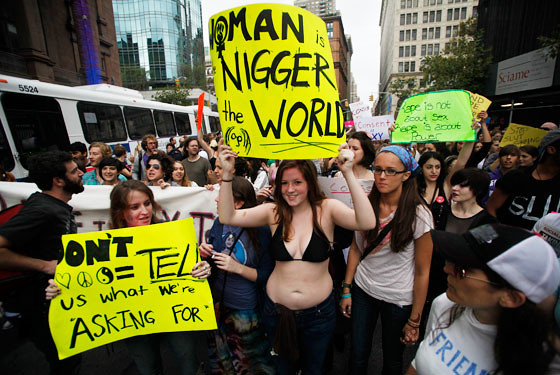
This pic is an example of what can occur when a populist feminist issue, in this case SlutWalk in New York, intersects with racial insensitivity. Read more about it at Racialicious. Obviously this young woman believes she's being progressive. In reality, she's being a dick, which ironically happens with unaware (or outright racist) feminists. All I have to say as a black woman is check your privilege, child.
BTW, I consider myself more of a womanist than a feminist.
Sharon Cullars Coffee Talk at 1/27/2009 01:34:00 PMPermanent Link |
|
Home
---------------oOo---------------
Monday, December 15, 2008
Can you love God and be a feminist?
Feministe ponders this question following a conference given by True Women, a Christian women's group that basically promotes the idea that feminism is antithetical to Biblical teachings. Unfortunately, I agree with the group that there is a contradiction to the independence (and in my opinion, basic self-respect) of a woman and the overt patriarchy and sometimes outright misogyny (fathers handing their daughters over for sacrifice and rape just doesn't sit well with me) in the Bible. Much of this has caused me a cognitive dissonance over the years that I have yet to reconcile. First off, I don't believe in kowtowing to any man, be he husband (hypothetical at this point), friend or foe. The word "feminism" is not a bad word to me, nor is the word "liberal," both of which I would use to describe many of my worldview leanings. I'm basically a humanist, and according to the Pentacostal doctrine under which I was raised and fostered, this has no place in the body of Christ.
Here is the vid promo for the conference. Let's just say my view of "true womanhood" differs greatly than that espoused by this group. I'm human first, woman second, and I can't subsume even a bit of my independence in the name of "true malehood."
Sharon Cullars Coffee Talk at 12/15/2008 09:07:00 PMPermanent Link |
|
Home
---------------oOo---------------
Tuesday, November 18, 2008
I'm not my butt...
...nor my hair. I am so much, much more... (to be hummed to the tune of Indie.Arie's song, "I'm Not My Hair"). Isn't it a shame that Ms. Arie has to remind us that it's not good to reduce people, specifically women, to superficial parts. So, like others in the blogosphere, I, too, take issue with Erin Aubry Kaplan's exploratory essay of Michelle Obama's posterior at Salon. Yes, the First Lady has nice curves, even I have noticed that. But I wouldn't write an in-depth article about it, especially when said article amounts to nothing more than an exercise in narcissism by the author. Kaplan obviously has some body image issues as her prior articles have critiqued her own bodacious anatomy. I sympathize, because I also have a bad body image. But it is quite presumptuous for Kaplan to pull someone else into her pique about how society doesn't fully appreciate her curves.
So we have a woman in the White House with curves, so what? As commenters of the Salon article point out, the whole self-serving article is particularly reductive. Yes, black women have been demeaned because of their bodies and shapes; most women of all cultures and races are similarly demeaned. How is further objectifying women going to help make you feel better about yourself?
As much as Kaplan believes Michelle's posterior in some ways validates her own ass, she has at least one pet peeve with the First Lady-Elect - her hair. Obviously, Ms. Obama isn't being "true" to her "blackness" by mainstreaming her hair. Or so Ms. Kaplan believes. Again, this is truly reductive. If we as black folk are nothing more than our discrete body parts and characteristics, where does that leave our character? Our intelligence? Our souls? "Soul" and "blackness" is a dynamic, ever-changing definition, more than skin color, more than hair texture, more than a particular style. More than the shape of an ass.
Yes, Ms. Kaplan, it's freeing to work out your own soul salvation, to come to terms with your self-reflection. But you don't have to reduce other folk while doing it. I don't know Ms. Obama personally, but I suspect that she would more appreciate being critiqued for her mind and not her ass.
Sharon Cullars Coffee Talk at 11/18/2008 11:48:00 AMPermanent Link |
|
Home
---------------oOo---------------
Thursday, May 24, 2007
Throwback to the past
Going through my Elan archives, I found this interview I conducted with sex psychologist Dr. Gail Wyatt in 2000. During a phone conversation, we discussed her book Stolen Women: Reclaiming Our Sexuality, Taking Back Our Lives. As I read over the interview, I realized how pertinent this book still is today. Below is an excerpt of our discussion:
How intricately connected is race with our sexuality, in the ways that we are defined as African-American women?
Sexuality is very integral to the identity of African-American women because of the stereotypes that have been promoted about us for centuries. This issue of sexuality should not be such a central defining point as it is for the African-American woman. However, given our history of slavery in this country and our sexual abuse and sexual ownership by other people, we have had a difficult time establishing and reclaiming our own rights to our sexuality and, along with that, the factual information that accurately describes our sexuality. So we are still countering misinformation that flourishes and continues to flourish about us in the media and we are still having to argue the point that we are not as sexual as we are assumed to be.
Continuing the issue of Black women and stereotypes, given the way that we’ve been negated and diminished throughout history, are we now starting to take control of our own images and, if so, in what ways?
I don’t think we are trying to take control of our images. No, unfortunately, I don’t see much progress in that area at all.
Not even now with more African-American women writing more movies and books?
I think we're writing about sexuality more, I think we're talking about it more, but I don't think we're reclaiming it because I think reclamation is defined as a process - that of understanding sexuality, and then expressing it, as well as controlling the images of it and the way that it is expressed and represented in the media. We have not taken an active part in that process of understanding, of reclaiming and of controlling the images.
Then how can we begin to take control?
Well, African-American women first of all need to understand their own sexuality, and we have not gone through this process. There’s a process of healing and a process of self-discovery as well as a process of group discovery that people have written about, that we have talked about among ourselves. It is that process that I think still needs to occur in every individual’s life.
Before we can start taking control?
Exactly. And when we do start to take control of our sexuality, then we will be a lot more vocal about the images that still flourish, those images that say African-American women’s breasts really ought to hang out, that our behinds should be defined by our clothes, and that our morals are very loose. Not to say that there are not women who actually live these stereotypes and who have attitudes and behaviors that perpetuate them, but we are not all like that. We don’t see the other end of the continuum and our daughters and our little sisters are exposed to information that makes the assumption that this is the way in which they should grow up.
Speaking of younger women, recent studies show that the teen pregnancy rate is dropping, especially in the African-American community. What do you think is contributing to this decline?
Well, I think we have more national programs that address the issue of contraception. Also, I think family planning has played an instrumental role in addressing teen pregnancy, as have some programs in the U.S. that have targeted teens in the last decade. We are now seeing the benefits of that targeting, which should have been done more in the past and which we should continue to do. Just because the rates are finally declining doesn’t mean that the rates aren’t extremely high, especially in communities of color. They are still too high. There is no reason in the world why a highly industrialized nation like the United States still has the number 1 rate of teen pregnancy and the number 1 rate of abortions. Obviously, we are still suffering from a lot of misinformation about sexuality and what responsibility people should have over it.
Given our society’s supposed sophistication about sex, it seems somewhat contradictory, if not hypocritical, that commercials regarding contraception and safe sex are still taboo, at least on the major networks. Is this self-imposed prudery hurting us as a society and are we undereducated as a society?
Yes. Our government really has not articulated a stance and, unfortunately, when Jocelyn Elders attempted to address some of these issues, you can see what happened to her. It is very prophetic that a Black woman was the one who tried to make very strong statements about our need to address sexuality - and the role it is supposed to play. Are people supposed to be educated about sexuality and given options? Or are we simply going to promote abstinence, which we already know doesn’t work. At least half of teenagers in the U.S. are sexually active by the age of 16. Abstinence may be effective for some people, but we don’t want to say that people should remain abstinent for the rest of their lives, especially since many people do not have the opportunity to marry. So, what is our message to them? Basically, we need a variety of messages that help people make informed decisions about sex and show the consequences of their actions. We need messages that extend beyond the point where the government is willing to go.
Essentially the government has passed the responsibility on to the states, and the states, in turn, have passed it on to the parents. And a lot of parents haven’t spoken out at all. We have heard more from parents who have said that they want to be the ones to control the information given to their children. Then these same parents go off to work and allow their children to look at the internet and educate themselves. So, kids are getting an education from watching television, from watching movies, and, although parents say they want to control the information, they don’t.
Sexual abuse is, unfortunately, not only a part of our community, but seems almost accepted in that it is not diligently reported and consistently condemned. Sometimes it seems we are penalized for speaking out for not being strong and just “grinning and bearing it”. What has your studies shown regarding the effects of rape and other sexual abuse against women and girls and the price of our silence?
Well, my research has shown that 1 in 3 women in their lifetime will experience at least one incident of sexual abuse, either before they are 18 or after they reach legal adulthood. Those rates are very high and they are higher than the likelihood that a woman will finish college. That is a very sad commentary in terms of what we can expect regarding ownership of our own bodies. It says that at some point, someone is going to take control of our bodies and, as a result, many women will suffer from very traumatic and harmful experiences and will have difficulty reclaiming their own bodies. The silence around this issue still comes from a lot of people assuming that sometimes these incidents are not as harmful as they really are. These people have not heard enough about the effects of traumatic sexual experiences on a person’s ability to make healthy decisions later in their lives should they decide to become sexually active on their own.
Sharon Cullars Coffee Talk at 5/24/2007 09:09:00 PMPermanent Link |
|
Home
---------------oOo---------------
Saturday, November 18, 2006
bell hooks - a personal hero
I first heard of bell hooks maybe fifteen years or so ago, but it took another few years before I actually picked up one of her books and that book became an epiphany for me. The book was Ain't I A Woman: Black Women and Feminism in which ms hooks eloquently discoursed on the trichotemy of race, gender and class from a black woman's perspective. I had rarely encountered a work that spoke to me, about me, for me. That's because in other analytical works and media, black women - and to some extent women, in general - remain largely invisible. Our hopes, dreams, lives are at best presented tangentially, as though the stories of our lives, triumphs and pains are subplots in another's patriarchal drama. As allaboutbellhooks.com, a dedication site notes, "bell hooks is one of America's most indispensable and independent thinkers and one of the foremost Black intellectuals in America today. hooks has described herself as a "Black woman intellectual, revolutionary activist." Soft-spoken, she expounds on incendiary issues without rancor or anger, but seeks to enlighten everyone how all of us suffer from the fallout of sexism and racism. She has taught at Yale and Oberlin as well as at inner city schools. She talks a little about her teaching experiences in the context of cultural criticism in this YouTube clip I found at another blog, Kuwaiti Femme.